

Tyler Muszelik’s Road to Redemption: How UConn’s Goalie is Making the Most of Second Chances

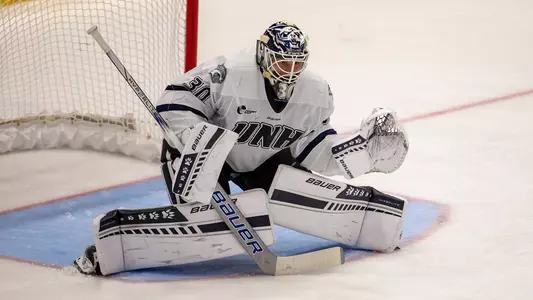
Before every game, UConn goaltender Tyler Muszelik reminds himself why he belongs on the ice. The back pad of his goalie mask serves as a visual reminder, adorned with personal symbols—an outline of New Jersey, his home; two cats, his childhood companions; and the initials of his family members, the people who inspire him. A cartoon moose, a nod to his nickname and imposing 6-foot-3 frame, sits at the center. Each element represents the journey that has shaped him, a journey marked by perseverance, setbacks, and second chances.
Muszelik’s pregame routine includes a mental checklist of his accomplishments, reinforcing his confidence before he steps between the pipes. He tells himself to trust his skills and just go play. But getting back to playing hasn’t always been so simple for the Florida Panthers draft pick.
Overcoming Injury and Uncertainty
Before college, Muszelik had never dealt with a serious injury. That changed during his sophomore season at New Hampshire when a right knee injury derailed his promising start. He played just eight games before losing his starting role and ultimately undergoing surgery. Transferring to UConn for a fresh start, he earned the No. 1 spot in net—only to suffer another setback in November, spraining his MCL in the same knee. Forced to the sidelines again, he faced six more weeks of recovery.
“It’s tough,” Muszelik admitted. “Honestly, the biggest thing I was focused on was that I can’t control what’s going to happen when I’m not playing. I just reminded myself to control what I could and make progress.
“You’ll get another chance, and when you do, take advantage of it. Simple as that.”
Simple in theory, but in reality, the road back was anything but easy.
From the Backyard to the Big Stage
Ironically, Muszelik’s entire goaltending career began as a second chance. At age 7, he stepped into net only because his team’s goalie was injured. A year earlier, he had walked away from hockey in tears, convinced it wasn’t for him. But the moment he donned the pads, everything changed.
“I fell in love with it there,” Muszelik said. “I was nervous and never thought about trying it, but I ended up being better than I thought. I just loved the feeling of being alone back there and having control over the game.”
That love carried him through two seasons with the U.S. National Team Development Program, onto the collegiate stage, and through the grueling rehab that threatened to keep him off the ice.
A Mental Reset and a Fresh Start at UConn
Last season, while spending more time in doctors’ offices than on the ice, Muszelik shifted his focus to mental strength. He reached out to former teammates and friends, making sure they knew how much he appreciated them. He meditated daily, instilling a belief in himself that would carry him through the toughest days.
“I wanted people to know I appreciated them,” Muszelik said. “That was a skill I lacked before that I tried to improve. It just improved my mood and sense of belonging. You can’t be a good goalie if you aren’t a good person first.”
When UConn head coach Mike Cavanaugh was searching for an experienced goaltender to add to his roster, Muszelik’s name surfaced. Before making the offer, Cavanaugh reached out to New Hampshire coach Mike Souza to get a sense of Muszelik’s character.
“He fits in our team seamlessly,” Cavanaugh said. “He’s a great kid. And that’s exactly what Mike Souza told us. He’s a great teammate, a competitor, and he wants the net in big games.”
Making the Most of His Comeback
Muszelik earned the starting job immediately at UConn, playing in 11 of the team’s first 12 games. Against No. 1-ranked Boston College, he stopped 17 of 18 shots before a collision in the second period forced him out of the game with another injury. Once again, he was forced to wait for his return.
Rather than dwell on frustration, he leaned on the relationships he had strengthened during his previous recovery. He knew he’d come back stronger—because he had done it before.
When Muszelik returned to action on Jan. 10, it was in a high-stakes matchup against his former team, New Hampshire. He turned away 27 of 28 shots, leading UConn to a 4-1 victory.
“That was a special one,” Muszelik said. “I went out with a few of my old teammates and talked with them, said hello to the coaches. It was nice to see those guys again. That was all nice. To get the win was even better.”
And he wasn’t done. Days later, he posted a 26-save performance in a 4-2 win over Maine. The following weekend, he started back-to-back games for the first time since November, stopping 35 of 36 shots in a win over Quinnipiac before shutting out Sacred Heart with 23 saves.
It was the culmination of everything he had worked for—the chance he had been waiting for, and the moment he refused to let slip away.
Lessons Learned and Looking Ahead
Muszelik’s journey has been defined by resilience, and his advice to younger players reflects that experience.
“My only advice would be that it’s going to be a lot harder than you think,” he said. “But you’re going to come out stronger on the other end of it.”
For now, he remains focused on the present, trusting in the process that has brought him this far. His mask will always remind him of where he’s been, but it’s his mindset that will determine where he’s going.
And as he’s proven time and time again, when given a second chance, he knows exactly what to do with it.