

Connecticut Huskies’ Resilient Run Towards Their First NCAA Tournament Berth

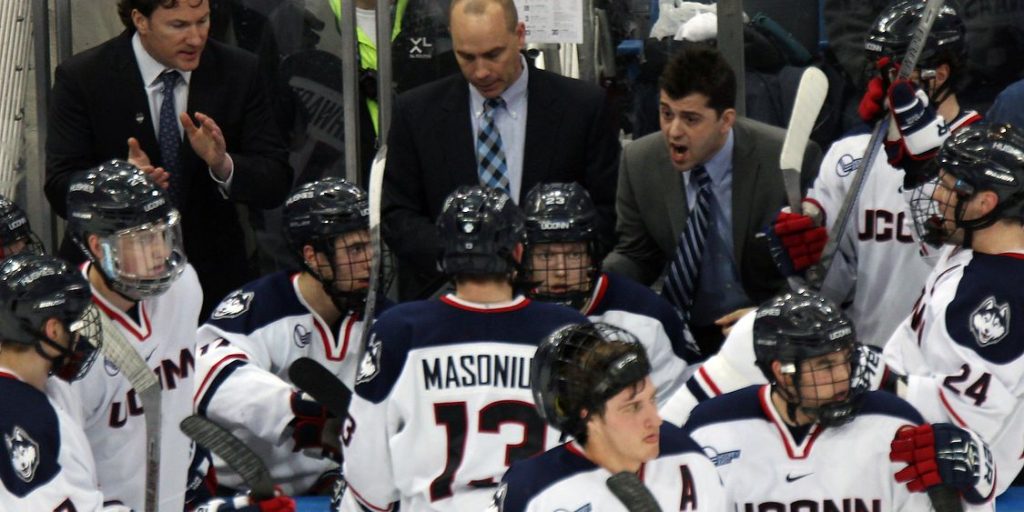
Connecticut hockey has always been on the cusp of greatness, consistently falling just short of earning a spot in the NCAA Tournament. Yet, this year feels different. Despite pre-season predictions placing them near the bottom of an extremely competitive Hockey East conference, the Huskies are not only competing—they are thriving. With back-to-back wins over New Hampshire last weekend, Connecticut surged to No. 11 in the Pairwise, positioning themselves for their first-ever NCAA Tournament berth.
However, the road ahead is no walk in the park. The Huskies face a daunting schedule with 14 games remaining, 11 of them against top-25 teams. While this might look like an obstacle to some, head coach Mike Cavanaugh sees it as an opportunity. Having previously helped guide Boston College to multiple NCAA appearances as an assistant coach, Cavanaugh knows that a tough schedule can be a double-edged sword.
“We’ve got 14 games left, 11 of which are against top-25 teams,” Cavanaugh said. “Some people would say that’s bad, but I look at it differently. Teams ranked around 14, 15, and 16 don’t have any games against teams in the top 20. They’ll almost have to run the table or win their conference tournament to get in. For us, it’s a chance to prove ourselves and continue to build on what we’ve started.”
While Connecticut’s position in the Pairwise is promising, their success is not merely the result of an easier schedule or a stroke of luck. This team has had to adapt, overcome challenges, and show resilience—qualities that have propelled them to where they are now.
Facing Adversity with Loyalty and Leadership
One of the key storylines for the Huskies this season has been the resilience of their team, especially following the departures of several key players. Top performers such as Matthew Wood, Samu Salminen, and Arsenii Sergeev all left the team—decisions that might have left many wondering about Connecticut’s future. But instead of faltering, the Huskies found new ways to move forward, thanks in large part to the leadership of fifth-year players Hudson Schandor and John Spetz.
When many expected the team’s morale to take a hit, Schandor and Spetz chose to return for their fifth years, a decision that Cavanaugh believes has had a profound impact on the team’s culture.
“Schandor and Spetz gave the team something invaluable—loyalty,” Cavanaugh shared. “They could’ve gone anywhere, but they chose to come back. It wasn’t just about their play on the ice; they set the expectations for the team, on and off the ice. Their leadership has been crucial in helping this team along.”
The duo’s commitment to the team not only reinforced their collective goals but also sent a powerful message to their teammates: if they could remain loyal to UConn in a time of uncertainty, so could others. This loyalty created an environment where every player on the team stepped up to the challenge, motivated by the belief that they could accomplish more than people expected.
A Strong Defense and Seamless Team Integration
Much of Connecticut’s success can also be attributed to how the team has come together despite personnel changes. Their defense, revamped with transfers and freshmen, has become a core strength. The freshmen, in particular, have exceeded expectations, with Cavanaugh noting the team’s improved mobility on the ice.
In the forward lines, five freshmen have integrated seamlessly into the team’s system. Along with the rise of several sophomores and juniors, the team has found balanced scoring across all four lines. The balance is key to Connecticut’s success—there’s no single standout player, but rather a cohesive unit working together to execute the game plan.
While no player is lighting up the stat sheet, the overall team production has been impressive. Cavanaugh pointed out that many players felt they had something to prove after the departure of key athletes.
“I think they took offense to the idea that our team was made up of more than just the guys who left. They’ve used that as fuel,” Cavanaugh said. This collective mentality has allowed Connecticut to thrive despite challenges.
The Goaltending Gamble
In net, Connecticut has been forced to adapt after the departure of Sergeev, with Tyler Muszelik coming over from New Hampshire to fill the goaltending hole. Initially, Muszelik was expected to compete for playing time with freshman Callum Tung, but injuries and illness made the situation more complicated. Muszelik and Tung both missed significant time earlier in the season, and the team was forced to rely on third-string goalie Thomas Heaney for several games.
However, the Huskies’ goaltending situation seems to be settling. With all three goalies healthy this past weekend, Connecticut earned two victories over New Hampshire. Muszelik made 27 saves in the first game, and Tung followed up with 26 saves in the second game.
“Having the goaltending trio back to full health has been huge for us,” Cavanaugh said. “It’s been a rollercoaster with injuries, but when we’re healthy, we can compete at a high level.”
Looking Ahead: No Easy Road
The Huskies are not out of the woods yet. The final stretch of the season will be incredibly difficult, with matchups against some of the top teams in the nation, including Maine and Providence. But Cavanaugh is optimistic.
“Playing against teams like Maine and Providence is exactly what we need to prepare for success down the stretch,” he said. “We’re getting tested, and that will make us stronger in the long run.”
With their resilience, leadership, and the way they’ve adapted to change, the Connecticut Huskies are making a strong case for their first-ever NCAA Tournament appearance. Their journey is far from over, but if they continue playing with the heart and determination they’ve shown so far, there’s no limit to how far they can go.