

Alumni Tracker: Meet Lindsay Dare Shoop

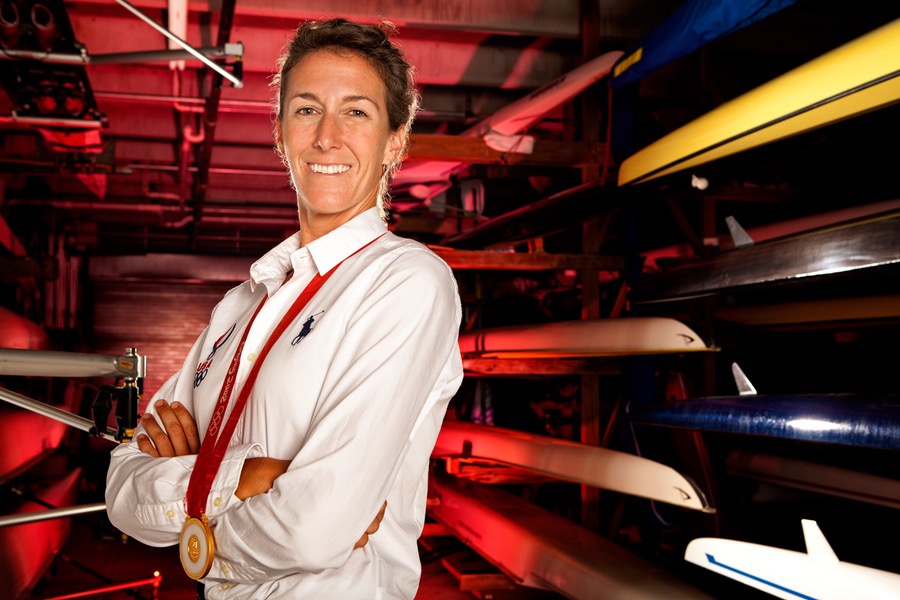
Lindsay Dare Shoop is one of the assistant coaches at the University of Virginia. She won Olympic gold in the women’s eight in 2008 and won three world championships in the women’s eight in 2006, 2007, and 2009. She is a two-time National Rowing Hall of Fame inductee. She wrote a book about her experience as an elite athlete called Better Great Than Never: Believing It’s Possible Is Where Champions Begin. She holds a master’s degree in exercise physiology and is a National Strength and Conditioning Association Certified Strength and Conditioning Specialist.
You began rowing as a walk-on your junior year of college. What inspired you to try and stick with the sport?
I played nearly a dozen sports growing up. Basketball was my main sport. Volleyball was my favorite. When I graduated from high school, I did not have the confidence to think I could play a sport in college, so I stopped. After two and half years of doing “all the things” that college kids do, my grades were dropping, my social habits were shifting, I had gained weight, and was the least fit I had ever been. Basically, I felt lost but did not know how to change course. Serendipitously, I bumped into Kevin Sauer (the then and current UVA head coach) on campus one day. He suggested I try rowing. His exact words were, “It’s never too late to row.” I told him I’d like that, took his card, and followed the steps to joining the team after that. What kept me in the sport was how welcomed I felt from day one and how the sport allowed me to explore becoming better. I was joining a team wrought with people that seemed a bit like me: awkward, lanky, quirky, athletic, smart, creative, fun, goofy, and likely all a little self-conscious at some point or another. As for becoming better, that progress and how it literally righted my ship, my grades, fitness, happiness, social support, all of it improved for the exponentially better. It quite literally changed my life. How could I not want to share this sport with others in case it might do the same for them?
What was your national team journey like?
During the first fall, I trained with Tom Terhaar and Laurel Korholz in New Jersey, in the hopes of making the team some day. Tom told Kevin Sauer that he did not know if things were going to work out for me. I was not performing very well at that point. Luckily, Kevin did not tell me that until many years later. After spending at least six or eight months training hard, struggling in the single, and hearing “good job” all of one time, something started to click and things started to improve. I had the good fortune of rowing with Molly Baker (a UVA teammate) and Megan Dirkmaat (Athens silver medalist) during the spring following that hard fall. The things they both taught me I still recall to this day. I cannot help but believe that had it not been for them and what I learned by rowing with them I would not have gone on to race my way to the top of the team’s pairs matrix for that year’s world championships team. As a result, I got to race in both the women’s pair and women’s eight at my first world championships.
From there, factor in a ton of erging, weightlifting, hill running, stationary biking, adventure runs with my teammates, dry-cracked and bleeding knuckles, losses, wins, near flips, flights all over the world, ups, downs, and even a bout with food poisoning, all culminating in some of the greatest friendships a person could ever hope for and you have a nutshell version of what it was like.
It was never about putting your head down and doing the work. It was, and still is, about discovering how to be really good at something by getting a little better each day. When that becomes your aim, and when you are surrounded by others whose aim is the same and you support each other through that, the rest becomes a byproduct of that behavior and takes care of itself.
You won Olympic gold in 2008, can you describe that experience?
I wrote a 386-page book about it and there is still more to tell. Here is an entry I wrote in my journal a couple of weeks after we won:
September 8, 2008: It’s been a few weeks, but we are still riding high. It is tiring but worth it. I feel empowered, like all my personality traits and emotions have intensified. I want to help people and be a part of everything. I want to inspire young minds. I understand the journey now. How much it is all worth.
Do not ever lose sight of what has to be done each day to get there. Enjoy the process. Every day. Simplify. Adjust. Ready for anything. Prepared for anything. Adaptable. Never forget the cold, long, hard days. The forty degrees and raining. The hypothermia. The tears, anxiety, and being down on myself. Deal with the good and the bad, and never forget what it has all been worth.Always remember. Always share. Always see the positive. Always work hard. Always be a champion in every aspect of life. I hope this will never fade. My life is forever changed.
Your 2008 Olympic gold medalist crew and 2009 World Championship win began a historic run of victories for the U.S. women’s eight. What do you think contributed to that immense success?
The 2006 crew of Brett Sickler (Gorman), Megan Cooke (Carcagno), Anna Goodale (Walker), Me, Anna Mickelson (Cummins), Susan Francia, Caroline Lind (Shald), Caryn Davies, and Mary Whipple (Murray) technically started the streak. We, with an average erg score of about 6:50, set a world best time of 5:55.5 in horrendous conditions. We even caught a mini-crab mid-race. When that happened, the commentators said about us, “It’ll be tough to set a world best time with a ‘shipwreck’ like that.” Pretty awesome that we went and did it anyway. Earlier that summer, this same crew set all the markers and course records at the Henley Royal Regatta and then went on to break the Head of the Charles record that same fall too.
What contributed to the success? Of course, there were the women and crews that came before us, but three key things I think made a huge difference:
- In 2005, after showing speed during the week of the world championships, our times put us on track to medal in both the women’s pair and the women’s eight. Caroline Lind and I doubled up that year. We were passed in the closing strokes in both finals, so we went home sixth in the pair and fourth in the eight. After spending the year doing more work than we had ever done in our entire lives, fourth and sixth are what we got. That set the tone for how we approached day one of the following year’s training.
- Knowing our result, Tom Terhaar sat us down and told us two things that I wrote on the back of my training log and have yet to forget: “Control what you can, ignore what you can’t.” and “Preparation equals confidence.” Those reset the tone and framed everything we did from there onward. At our first race of the 2006 season, the Henley Royal Regatta, we set all the records before starting the 11-year streak. I’m still waiting for Brett and Cooke to be inducted into the Hall of Fame. They didn’t make the Beijing eight, but that eight wouldn’t have won without them.
- The Beijing era of athletes was a special group. It was a positive environment. When you are working that hard, as much as possible, you must be positive and uplifting. We supported one another. We laughed at and with one another. We left no one behind. We knew never to pass anyone when running downhill, only on the way up. We knew that the consequences of rowing over rate would impact us all and not just the one who was over rate. We were on that crazy journey to becoming something great together. Had it not been for our true team-ness, it never would’ve worked. As Mary put it, we flowed. In the boat. Out of the boat. We just flowed.
I must reitirate, it was never about putting your head down and doing the work. It was, and still is, about discovering how to be really good at something by getting a little better each day. When that becomes your aim, and when you are surrounded by others whose aim is the same and you support each other through that, the rest becomes a byproduct of that behavior and takes care of itself.
There are many seemingly “small” things that made it happen, including the characteristics that made the Beijing group so special, and each of those things are core components to my coaching philosophy today.
What is your coaching philosophy?
In one sentence, when you do the right thing or the right things, the winning takes care of itself. I also believe it’s important that each person feels they can comfortably be themselves. Teams should exist to help us all grow into who we are. To cultivate the possibility within.
From the coaching side, I find inspiration to be a two-way street. By lighting someone else’s fire, we end up lighting our own. It’s all about bucket filling. Other than that, I aim to teach the true value and meaning of mastery and goal setting. Quite often, I hear those two things overlooked or incorrectly taught. I also do not believe that injury is a part of the process. If it becomes a trend, then we, as coaches, are missing something.
What or who inspired you to become a coach?
My mom always said I would be a great teacher. I always resisted it. Because, you have to resist what your parents suggest to you when you are in your teens and twenties. I very organically fell into coaching as a part-time job while I was waiting to start work in Ocean Rescue. I became an EMT/Open water rescuer in Miami Beach after I left the training center. When I started dabbling in coaching, I instantly fell in love with it.
Facilitating aha! moments has a lot to do with it. Seeing others find empowerment through their own actions makes my heart sing. So if I am able to have even a small part in creating an environment that helps others find empowerment, that is what inspires me to keep at it. I’ve come to realize that rowing is my ikigai.
What advice would you give to anyone considering becoming a coach?The first things that come to mind:
Read:
- Rowing Rudern: The GDR Text on Oarsmanship
- Advanced Concepts of Strength and Conditioning (NCSF)
- Tribal Leadership
- The Passion Paradox
- Body Mind Mastery
And remember:
- Whatever you do, be consistent.
- It’s all about them.
- This will be hard.
- Trust makes the boat go.
What makes a great rower?
Patience. Curiosity. Length of limb. A love of learning and improvement. Sense of humor. Glass half full perspective. A strong sense of team. Team. Team. Team. Team. I hope we can bring back novice rowing. Five rowers from the men’s Athens gold medal eight learned to row in college. Five of us in the women’s gold medal eight in Beijing learned to row in college. Coincidence? I don’t think so.You are a National Strength and Conditioning Association Certified Strength and Conditioning Specialist and have a master’s in exercise physiology. What do you think is the most important thing many coaches ignore in their training?
Ensuring proper mobility, joint stability, and having the patience to train physically. This means to take time early in the season to ensure mobility and joint stability while focusing on proper technique. This frees up the rest of the season to make greater gains than you would otherwise see. Being in a hurry and focusing on volume and quantity over quality is an unfortunate trend at the moment.
For reference, do you know what my first practice with the national team coaches entailed? Cleaning the boathouse for several hours, before learning how to properly carry and care for our borrowed singles, and learning we would need to buy reliable heart rate monitors and speed coaches. After that, we rowed for 20 minutes. The significance of what Tom had us do that day: He showed us that patience, accountability, and trust make the boat go. Without those, even the best training plan in the world would be less effective.
How can institutions support the development of women as coaches?This is a tough question because different institutions support coaches in their owns ways. I’d say the biggest thing is not necessarily institutions, but coaching staffs need to be really good at working as a team. We could all use regular reminders to leave our egos at the door and recognize our strengths and weaknesses. Because it takes a team to get it all done. Supporting and paying assistants according to the demands of the job, regardless of whether they are male or female would also help. Highly skilled assistants are lost because they are overworked. Since it takes a team of skilled coaches to make it all work, we have to keep the good ones in the game by all means.
For me personally, I find balance, trust, support, autonomy, and teamwork critical. Without those, you are apt to attempt to do too much. I went through overtraining once as an athlete and it was one of the scariest, most confusing times of my life. After two years of grad school overlapped with five years of full-time NCAA coaching, I started to feel similar symptoms like those I went through when I experienced overtraining as an athlete. That was a second scary, confusing time in my life and is part of what drove me out of NCAA coaching back in 2019. So whatever institutions can do to help coaches stave off those physiological and psychological implications, that’s the answer to the question.
This article was provided courtesy of US Rowing.